Volume 2 Issue 2
Soil loss under different harvest managements of some vegetables in lower
Gangetic plains of Nadia district in West Bengal
Author(s): N. C. DAS, SOMESH MAHAPATRA AND PHOOL CHAND
Abstract: In order to investigate the loss of soil from up and medium land situations through harvest managements of some
vegetables, both field experiments on farmers plots and survey works were conducted in winter, summer and rainy
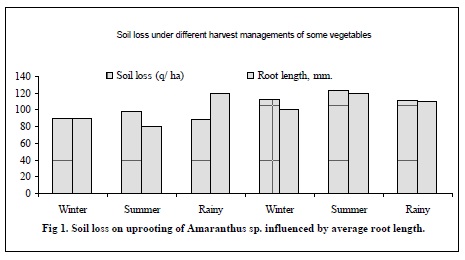
seasons of the year 2003 04. Field observations on soil loss, number of plants, plant height, root length, root
weight, and soil moisture at harvest were recorded. Farmers, retailers and wholesalers from adjacent daily and
wholesale markets were interviewed towards having information regarding faulty harvesting managements of
vegetables. The respondents available were in the ratio of 1:2:1. It was found from the survey report that red and
green Amaranthus species, spinach and radish were commonly grown vegetables subjected to have faulty
harvesting practices either uprooting only or uprooting and washing. Red Amaranthus species was the most
frequently grown vegetable of which almost 100% was found harvested with faulty practice by retailers and
wholesalers. Average loss of soil on uprooting the plants was found to be correlated with respective means of
number of plants, root weight, plant height, root length and soil moisture at harvest in varying level of association
varied in different seasons of both the land situations. The highest loss of soil (i.e.115.11gm m-2) by the faulty
practice was found in medium land. The biomass yield of Amaranthus species varied within a range of 40.9 - 56.4
tonnes ha-1. Thus the average loss of soil along with fresh organic substances due to faulty harvest management in
Amaranthus species was estimated as 1.75 tonnes ha-1 cultivatio-1 year.
Download Full Article : Click Here
